

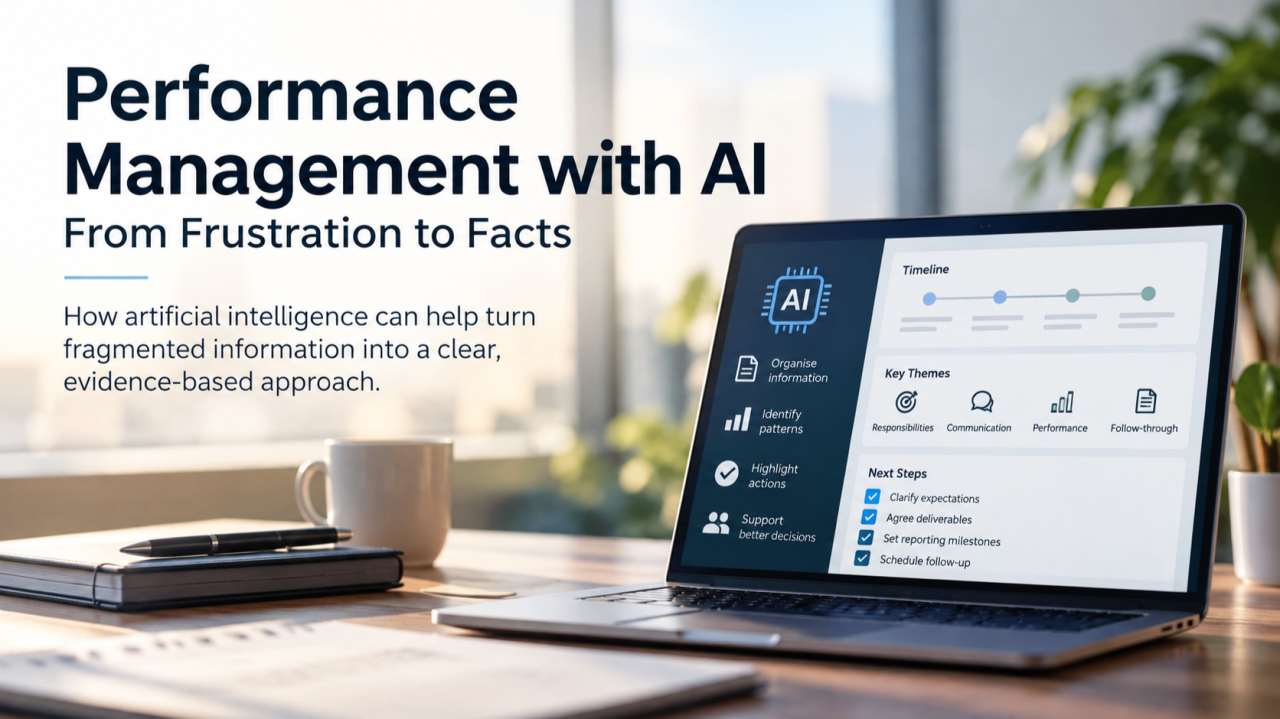
One of the greatest challenges in performance management is separating what we feel from what we can actually demonstrate.
When expectations are not being met, frustration can build. Conversations become repetitive, commitments are remembered differently, and the distinction between what was agreed, what was delivered and what remains outstanding becomes increasingly blurred.
Recently, I used artificial intelligence to help me work through a real-world performance management challenge.
The experience reinforced something I have long believed as a project manager:
Effective management is not about controlling people. It is about establishing clear expectations, maintaining visibility, measuring outcomes and creating accountability.
AI proved particularly valuable in helping me apply those principles consistently.
The Challenge
I was dealing with a situation involving an individual who had undertaken a number of responsibilities over an extended period.
There had been numerous conversations, requests, commitments, explanations and follow-ups.
Much of this information existed across different communication channels, including email, messaging applications and various documents.
The difficulty was not necessarily a lack of information.
It was that the information had never been brought together into a coherent, objective picture.
Trying to reconstruct everything manually would have been time-consuming, and relying on memory alone risked introducing personal bias.
This is where I decided to introduce AI.
My Approach: Six Practical Steps
1. Gathering the available evidence
I started by identifying the relevant historical information, including:
- Email correspondence
- Messaging conversations
- Previous commitments and instructions
- Progress reports and supporting documentation
- Records of completed and outstanding activities
The objective was to establish a factual baseline rather than rely on recollection or perception.
2. Establishing a chronology
I then used AI to help organise the available information into a chronological sequence.
This allowed me to examine when responsibilities were agreed, when actions were expected, what responses were provided and which matters remained unresolved.
A chronology is particularly useful because isolated incidents can be misleading. Patterns over time often provide a more meaningful understanding of performance.
3. Separating facts, assumptions and explanations
This was arguably the most valuable part of the exercise.
I asked AI to help distinguish between:
- What could be supported by documentary evidence
- What had been reported but not independently verified
- What had been promised
- What had actually been delivered
- What remained uncertain or required clarification
Importantly, AI was not there to decide who was right or wrong.
Its role was to help me assess the available evidence more systematically and identify gaps in my understanding.
4. Identifying recurring performance issues
With the information organised, I could look beyond individual incidents and examine recurring themes.
These included clarity of responsibilities, communication, timeliness, follow-through, reporting and accountability.
This helped distinguish between possible capability issues, unclear expectations, competing priorities and failures to deliver against agreed commitments.
These distinctions matter because different problems require different management responses.
5. Developing a constructive management response
Rather than immediately drafting a message based on frustration, I used AI to explore how the situation could be addressed professionally and proportionately.
The resulting approach concentrated on establishing clear expectations, agreeing realistic deliverables, defining reporting requirements and identifying appropriate follow-up actions.
The emphasis was on improving future performance rather than simply revisiting past disappointments.
6. Reviewing the proposed communication
Finally, I used AI to help structure a measured written communication.
I reviewed the draft for factual accuracy, fairness, tone and clarity.
I wanted the message to be firm without becoming unnecessarily confrontational, and to distinguish documented shortcomings from matters that still required discussion.
The final judgement, including what was reasonable to expect and how to proceed, remained entirely mine.
What Did AI Actually Achieve?
The immediate benefit was not an automated performance rating or a disciplinary recommendation.
It was something considerably more practical.
AI helped me turn a collection of disconnected communications and observations into a structured basis for management decisions.
It helped reduce the administrative effort involved in reviewing historical information, highlighted inconsistencies and enabled me to approach a potentially emotional situation more objectively.
It also helped me challenge my own assumptions.
That final point is particularly important.
AI is most useful when we ask it to challenge our thinking, not simply validate our opinions.
The Importance of Human Judgement
There are important limitations.
AI can misinterpret communications, overlook context or present incomplete information with unwarranted confidence.
It cannot establish someone's motivation simply by analysing their messages. Nor should an AI-generated assessment be treated as conclusive evidence of poor performance.
Confidentiality, data protection, appropriate authorisation and the individual's opportunity to respond must remain central to the process.
For me, AI was a management support tool, not a replacement for management responsibility.
Why This Matters for Project Management
The same approach applies far beyond this particular situation.
Consider a project manager responsible for multiple contractors, suppliers, consultants or geographically dispersed teams.
Performance-related information may be scattered across meeting minutes, emails, progress reports, action registers and messaging platforms.
AI can help bring that information together, identify outstanding commitments, highlight inconsistent reporting and prepare structured follow-up communications.
This is particularly valuable in remote project management, where the manager may not have continuous physical visibility of activities.
A project manager does not need to observe every activity personally to maintain effective control. What matters is having reliable information, clearly defined responsibilities and a disciplined process for verification and follow-up.
AI can make that process considerably more efficient.
My Takeaway
This exercise reinforced my view that AI's value in management is not limited to automation or generating content.
Its real potential lies in helping experienced managers process information, test assumptions, recognise patterns and make better-informed decisions.
But the fundamental principles have not changed.
We still need clear expectations, evidence, fairness, communication and accountability.
AI does not make someone a good manager. It can, however, make a good manager considerably more effective.
And perhaps that is where some of its greatest practical value lies.
I'd be interested to hear from other project managers and business leaders: Have you used AI to support performance management or improve accountability? Where do you draw the line between AI-assisted analysis and human judgement?
#ArtificialIntelligence #PerformanceManagement #ProjectManagement #Leadership #AIinBusiness #RemoteProjectManagement #Accountability #ContinuousImprovement